

Recommended Discounts

Zenless Zone Zero(ZZZ)
Zenless Zone Zero Top Up is now available at Buffget with cheap price and fast delivery. Find the best deals for Zenless Zone Zero Monochrome and enjoy your game journey
27.63% OFF
Related articles


ZZZ Disk Tuning Guide 2026: Battery Charge vs Anomaly
This guide analyzes Battery Charge versus Anomaly sub-stats in Zenless Zone Zero disk tuning. We examine Polychrome investment efficiency, agent-specific priorities, and DPS calculations to help mid-to-endgame players optimize resources. Learn which stats maximize Anomaly agent performance and avoid common Polychrome waste.
Buffget
Understanding ZZZ Disk Tuning Mechanics
Drive Disc optimization drives endgame progression. Six partition slots feature fixed main stats and randomized sub-stats determining combat effectiveness.
Partition 4 offers Anomaly Proficiency as main stat (9-54 at max level) alongside HP%, ATK%, DEF%, CRIT Rate%, CRIT DMG%. Partition 6 provides Anomaly Mastery% competing with HP%, ATK%, DEF%, Impact%, Energy Regen%. These partitions define Anomaly build potential.
For efficient resource acquisition, Zenless Zone Zero top up at buffget provides competitive Polychrome rates with secure transactions.
Sub-Stat System Mechanics
S-Rank discs start with 3-4 substats, max at level 15. Upgrades trigger at +3, +6, +9, +12, +15—either enhancing existing substats or adding new ones.
Substat ranges for S-Rank:
- CRIT Rate: 2.4%-14.4%
- CRIT DMG: 4.8%-28.8%
- ATK%: 3%-18%
- Anomaly Proficiency: up to 54 points
Reaching level 15 costs 48,000 EXP and 72,000 Dennies per disc. Poor main stat choices can't be fixed through substat tuning.
Tuning Costs and Success Rates
Battery Charge farming via Routine Cleanup costs 60 Battery Charge per run (unlocked at Inter-Knot Level 30). Regenerates 1 point/6 minutes, 240 cap.
Polychrome refill costs:
- First refill: 50 Polychromes for 60 Battery Charge
- Eight daily refills: 900 Polychromes total (480 Battery Charge)
Version 2.5 (Dec 30, 2026) introduced Substat Tuner requiring 1-2 Calibrators per reroll. First 10 rerolls cost 28,800 Polychromes. Full six-disc optimization needs 12+ Calibrators minimum.
Main Stats vs Sub-Stats Priority
Main stats provide guaranteed bonuses dwarfing substats. Anomaly Proficiency main stat delivers 54 points—matching maximum substat value.
Partitions 1-3 lock to Flat HP/ATK/DEF. Strategic decisions concentrate in Partitions 4-6. Anomaly agents target Anomaly Proficiency (P4) and Anomaly Mastery (P6) as main stats.
Partition 5 offers elemental damage bonuses matching agent damage type—superior to generic ATK% for consistent amplification.
Battery Charge Deep Dive

Battery Charge accelerates energy accumulation for Ultimate abilities. The stat appears exclusively as substat, never main stat—limiting maximum values versus stats occupying both slots.
Combat Functionality
Battery Charge multiplies base energy generation from attacks, damage taken, and specific mechanics. Benefits scale with fight duration. Short encounters (30-60s) see minimal impact—agents cast 1-2 Ultimates regardless. Extended Shiyu Defense and boss fights provide more leverage opportunities.
Swing Jazz 2-piece grants +20% Energy Regen. Matching this via substats alone requires multiple high-roll Battery Charge substats across discs, showing set bonus efficiency.
Ultimate Uptime Impact
Support agents with team-buffing Ultimates gain more value from Battery Charge than damage dealers. Additional support Ultimate affects all damage output; extra DPS Ultimate adds one personal damage instance.
Anomaly agents face unique consideration: damage comes primarily from Anomaly buildup and Disorder triggers, not Ultimates. Heavy Battery Charge investment underperforms versus maximizing Anomaly Proficiency and Mastery.
Breakpoints and Diminishing Returns
First 20% Battery Charge provides noticeable improvements. Beyond 40% yields progressively smaller gains.
Soft caps around 30-35% Battery Charge for most agents. Beyond this, additional investment rarely enables extra Ultimate casts in typical encounters.
Opportunity cost: Battery Charge substats occupy slots for CRIT Rate, CRIT DMG, ATK%, or Anomaly stats. For damage dealers, 10% CRIT Rate often outperforms 20% Battery Charge in total damage.
Anomaly Sub-Stats Explained
Anomaly agents (Jane Doe, Grace Howard, Burnice White, Miyabi) operate on different damage mechanics. Anomaly Mastery, Proficiency, and Penetration Ratio directly multiply Anomaly damage and buildup speed.
Anomaly Mastery Scaling
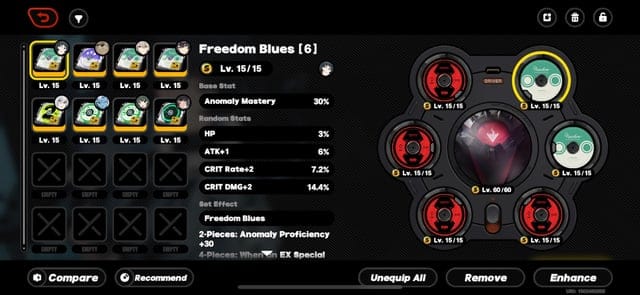
Anomaly Mastery appears as Partition 6 main stat. 140 flat Mastery represents endgame benchmark. The stat multiplies base Anomaly damage through percentage increases—unlike ATK% which only affects attack damage.
Disorder compositions amplify Mastery value. Disorder triggers when applying second Anomaly type to enemy with different Anomaly, creating explosive damage. Higher Mastery increases both initial Anomaly damage and Disorder explosion.
Anomaly Proficiency Buildup Speed
Proficiency determines how quickly agents fill enemy Anomaly meter. Higher values reduce hits required to trigger Shock, Burn, or other effects.
S-Rank Proficiency main stats (P4): 9-54 points at max level. Substats add up to 54 points per disc. Endgame builds target 100-150 total Proficiency.
Freedom Blues and Chaos Jazz sets each provide +30 Proficiency via 2-piece bonuses—foundation for most Anomaly builds.
Penetration Ratio for Endgame
PEN Ratio reduces enemy Anomaly resistance, functioning as damage multiplier against high-resistance enemies. Appears as Partition 5 main stat.
Guidelines: below 30% enemy resistance, prioritize elemental damage; above 40% resistance, PEN Ratio gains efficiency.
Disorder Amplification
Disorder damage calculation incorporates both agents' Anomaly Mastery values. The formula applies higher Mastery value, then adds percentage of second agent's Mastery—rewarding balanced team investment.
Practical Disorder building requires coordinating Anomaly types. Pairing Electric (Shock) with Fire (Burn) enables consistent triggers. Each agent maximizes individual Proficiency for rapid buildup; Mastery investment on both compounds Disorder damage.
Battery Charge vs Anomaly Stats: Direct Comparison
Anomaly agents derive 60-80% total damage from Anomaly triggers and Disorder, not Ultimates. This distribution suggests Anomaly stats receive priority.
For efficient testing of both approaches, buy ZZZ Polychromes through buffget's secure platform with competitive pricing.
DPS Mathematical Models
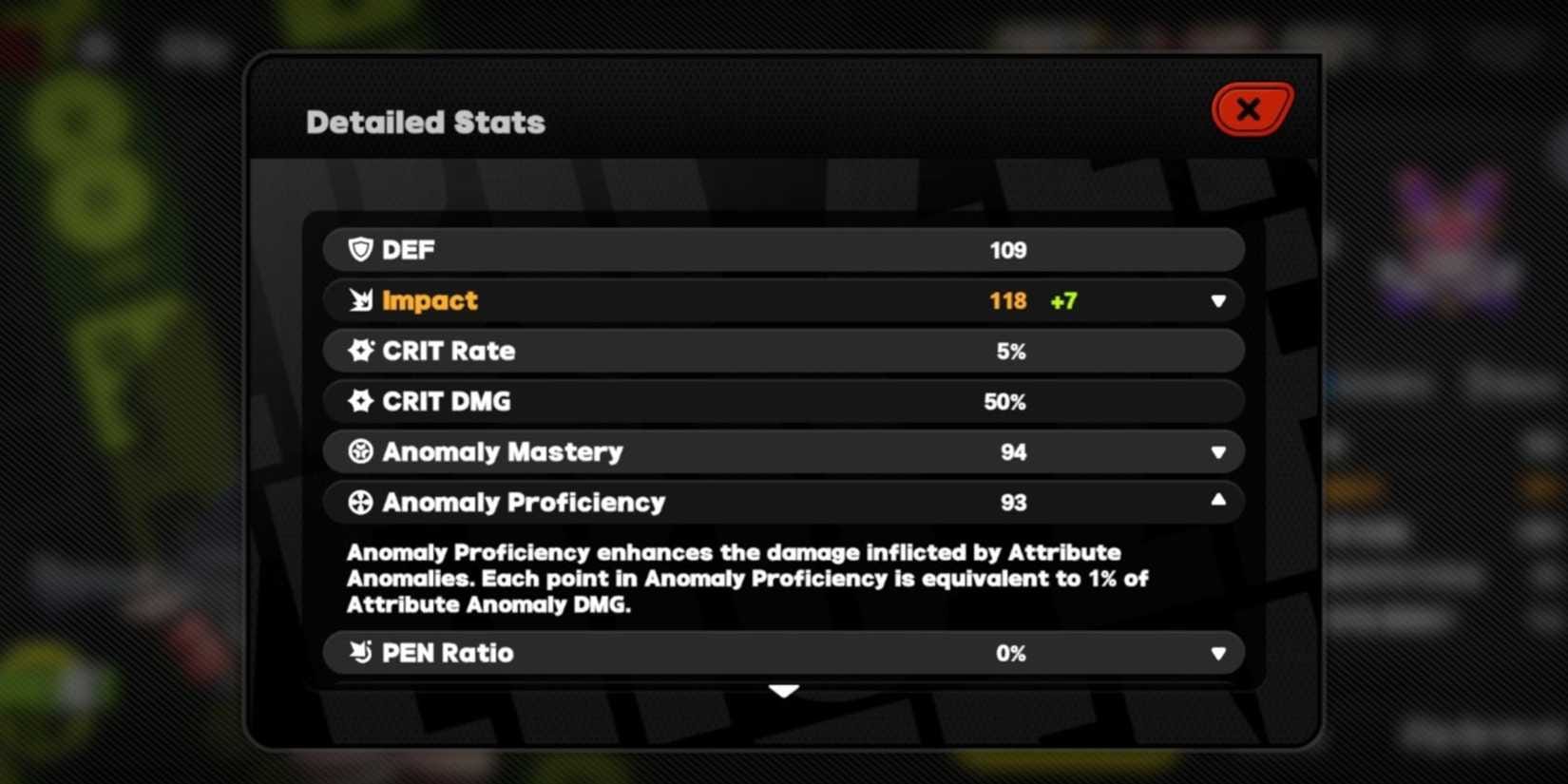
Anomaly Proficiency: 50% Proficiency increase enables triggers in 67% original time—effectively 50% damage frequency increase.
Anomaly Mastery: 40% Mastery increase boosts all Anomaly damage by 40%. With Anomaly representing 70% total output, this translates to ~28% total damage increase.
Battery Charge: 30% increase might enable one additional Ultimate in 90s encounter. If Ultimate deals 15% total damage, actual increase equals ~15%. This shows why Anomaly stats typically outperform Battery Charge.
Team Composition Impact
Solo DPS Anomaly agents maximize Proficiency and Mastery—damage output directly determines clear speed.
Disorder teams: primary applier maximizes Proficiency for rapid buildup. Secondary agent balances Proficiency and Mastery for Disorder triggering and uptime maintenance.
Support-oriented Anomaly agents in triple-Anomaly teams might justify modest Battery Charge if Ultimates provide team buffs. Even then, reach Anomaly thresholds (100+ Proficiency, 120+ Mastery) first.
Real Combat Testing
Shiyu Defense floor 100 with Jane Doe: builds with 130 Proficiency/150 Mastery consistently outperform 100 Proficiency/120 Mastery/35% Battery Charge builds despite latter casting one additional Ultimate.
Grace Howard in Deadly Assault: maximizing Shock damage through Anomaly stats produces faster clears than Ultimate-focused builds.
Burnice White partial exception: Ultimate's team-wide Fire buff makes Battery Charge enabling extra cast marginally valuable. Still, reach 120+ Proficiency/140+ Mastery first.
Polychrome Investment ROI
Tuning costs scale predictably: 28,800 Polychromes for first 10 rerolls. Optimal substats across six-disc set typically requires 12+ Calibrators (34,560+ Polychromes). This guarantees measurable improvements versus gacha uncertainty.
Average Tuning Costs
Good enough substats (three relevant substats per disc, moderate rolls): 15,000-20,000 Polychromes per six-disc set. Provides 80-90% maximum performance—efficiency sweet spot.
Perfect substats (four optimal substats, max rolls): can exceed 100,000 Polychromes per set due to compounding RNG. Performance gain from 90% to 100% rarely justifies cost for limited budgets.
Expected Value by Stat Type
Anomaly Proficiency substats averaging 35-40 points across six discs provide 210-240 total Proficiency. Combined with main stats and set bonuses, reaches 100-150 endgame threshold. Expected cost: 18,000-25,000 Polychromes.
Anomaly Mastery main stat (P6) provides bulk value. Substat contributions add 15-25% additional Mastery. Tuning costs lower than Proficiency since main stat provides foundation.
Battery Charge optimization costs mirror Proficiency (20,000-30,000 Polychromes) but performance return proves substantially lower for Anomaly agents—unfavorable ROI.
Breakeven: Tuning vs Agent Pulls
Guaranteed S-Rank pull requires up to 90 pulls (14,400 Polychromes worst-case pity). New agents provide entirely new gameplay options. Tuning improves existing agents incrementally.
Breakeven depends on account maturity:
- New players with incomplete rosters: agent pulls expand options
- Veterans with comprehensive rosters: tuning provides better incremental gains
Content clearing capability: if current disks prevent clearing endgame, tuning enabling progression unlocks reward tiers worth more than cost. If content clears comfortably, tuning provides only time-saving benefits.
Long-Term Sustainability
Meta shifts devalue tuning investments. Perfectly tuned Anomaly set loses value if patches introduce mechanics favoring different distributions. Agent pulls maintain value longer through team composition adjustments.
New disk sets create obsolescence risk. Conservative tuning—reaching good enough thresholds rather than perfection—maintains flexibility.
Account-wide resource accumulation favors balanced investment. Moderate tuning across multiple agents provides broader improvements than perfect tuning on single agent.
Agent-Specific Recommendations
Anomaly Agents Priority Lists
Jane Doe (Physical Anomaly):

- Anomaly Proficiency to 120+
- Anomaly Mastery to 130+
- ATK%
- Battery Charge (only after reaching thresholds)
Grace Howard (Electric Anomaly):
- Anomaly Proficiency to 100+
- Anomaly Mastery to 150+ (Shock DoT benefits)
- ATK%
- Battery Charge (low priority)
Burnice White (Fire Anomaly):
- Anomaly Proficiency to 110+
- Anomaly Mastery to 140+
- Battery Charge 15-20% (Ultimate team buff justifies)
- ATK%
Miyabi: Follow standard Anomaly priority—Proficiency and Mastery first, defensive stats if needed, Battery Charge last.
Attack Agents
Optimize CRIT Rate to 60-70%, CRIT DMG to 120-150%, then ATK%. Battery Charge consideration depends on Ultimate damage contribution.
If Ultimate contributes 30%+ total damage, modest Battery Charge (15-20%) provides reasonable returns. Below 30%, CRIT and ATK substats outperform.
Elemental damage bonus main stats (P5) universally outperform Battery Charge—consistent amplification across all attacks.
Support Agents
Team-buffing Ultimates represent Battery Charge's strongest use case. Enabling additional buff uptime affects all team damage. Support builds justify 25-35% Battery Charge after meeting defensive requirements.
Energy Regen% main stat (P6) provides larger gains than substats alone. Combine with moderate Battery Charge substats for maximum Ultimate frequency.
Meet defensive thresholds (HP%, DEF%) before energy optimization. Dead supports provide zero value regardless of Battery Charge.
Stun Agents
Focus Impact stat for Daze buildup. Impact% main stat (P6) takes priority over energy stats.
Shockstar Disco 4-piece boosts Daze buildup 20%, providing substantial Impact via set bonus. This reduces substat reliance, potentially freeing slots for modest Battery Charge if Ultimate utility justifies.
Stun rotation timing aligns with natural energy generation—agents build energy while applying Daze, cast Ultimates during/after stun windows. This synchronization reduces Battery Charge value.
Optimal Tuning Strategies by Profile
F2P Resource Allocation
Prioritize correct main stats over perfect substats. S-Rank with optimal main stat and mediocre substats outperforms perfect substats with wrong main stat.
Target good enough: two relevant substats per disc, average rolls. Achieves 70-80% maximum performance while preserving Polychromes for agent pulls.
Set bonuses provide efficient gains without tuning costs. Freedom Blues and Chaos Jazz 2-piece grant 30 Proficiency each—equivalent to multiple perfect substat rolls. Complete sets through farming before substat rerolling.
Dolphin Spenders
Identify 2-3 most-used agents, invest 15,000-20,000 Polychromes per agent targeting three relevant substats per disc with above-average rolls.
Spread tuning across multiple agents rather than perfecting singles. Three well-tuned agents outperform one perfect and two poor in multi-team content.
Time investments around banners: tune during downtime, accumulate Polychromes, spend on priority banners.
Whale Optimization
Target four optimal substats per disc with maximum rolls. Exceeds 100,000 Polychromes per set but provides absolute performance ceiling.
Use Advanced Tuning at Bardic Needle (requires 3 Hi-Fi Master Copies per guaranteed S-Rank). Systematically dismantle suboptimal discs to accumulate Copies for targeted partition farming.
Perfection thresholds for Anomaly: 150+ Proficiency, 160+ Mastery, four relevant substats per disc all max rolls.
New Player vs Veteran
New players (Level 30-40): Focus correct main stats in P4/5/6 with any S-Rank discs. Substat tuning provides minimal value when basic optimization incomplete.
Veterans (Level 50+): Complete rosters and cleared content allow focus on incremental improvements compounding into competitive advantages.
Transition point: when main stat optimization completes across primary teams. Once core agents possess correct main stats, shift Polychrome allocation toward substat tuning.
Common Mistakes
Over-Investing in Battery Charge
Stop at role-appropriate thresholds:
- Anomaly DPS: 0-10%
- Attack DPS with impactful Ultimates: 10-20%
- Support with team buffs: 25-35%
Test actual clear times. Record 10 clears with 15% Battery Charge, then 10 with 35%. If average improves less than 5%, additional investment fails cost-benefit versus alternative stats.
Ignoring Set Bonuses
Set bonuses provide concentrated gains often exceeding achievable substat totals. Freedom Blues 2-piece grants 30 Proficiency—equivalent to multiple perfect rolls. Breaking sets for marginally better substats frequently reduces total stats.
Four-piece effects provide combat mechanics substats can't replicate. Shockstar Disco 4-piece boosts Daze 20%—multiplicative effect maintaining priority over incremental substats.
Tuning Wrong Positions First
P4 and P6 provide highest-impact stats—priority tuning targets. Investing in P1-3 (locked flat stats) before optimizing P4-6 wastes resources.
Optimization sequence:
- Correct main stats P4/5/6
- Set bonus completion
- Substat tuning P4/5/6
- Substat tuning P1/2/3
P5 elemental damage bonuses deserve special attention—30-40% amplification to all attacks outweighs P1-3 substat perfection.
Meta Chasing
Tuning based on current meta creates obsolescence risk. Conservative tuning reaching good enough thresholds provides meta adaptation flexibility.
Future-proof building prioritizes versatile stats. Balanced Proficiency and Mastery serves multiple Anomaly agents across patches. Extreme specialization creates inflexible builds requiring expensive retuning.
Advanced Optimization
Stat Weight Calculators
Assign numerical values to each stat based on damage contribution. Typical Anomaly weights: Mastery 1.0, Proficiency 0.8, ATK% 0.4, Battery Charge 0.2.
Efficiency scoring compares current stats against theoretical maximum. 75% efficiency has meaningful improvement room. 92% efficiency provides minimal upgrade potential—questionable further investment.
Team Synergy Multipliers
Team composition affects individual stat value. Anomaly agent in Disorder team gains amplified Mastery value due to Disorder calculations. Same agent solo sees lower Mastery value, shifting priorities toward Proficiency.
Energy generation support from teammates reduces Battery Charge value for DPS. If supports provide energy via abilities/sets, DPS requires less personal investment.
Patch Cycle Timing
Time large investments for mid-patch periods (3-4 weeks post-release). Allows meta stabilization and community testing before committing Polychromes.
Enter patches with 20,000+ saved Polychromes for rapid adaptation—immediate tuning of new agents or adjustment to new meta.
Hybrid Build Flexibility
Some agents perform multiple roles. Hybrid disk sets with balanced stats enable flexibility without multiple complete sets. Sacrifices 5-10% peak performance per role but eliminates duplicate costs.
Hybrid Anomaly builds balance Proficiency and Mastery equally. Performs adequately in solo DPS and Disorder support—85-90% specialized performance at 50% tuning cost.
Practical Action Plan
Step 1: Audit Current Inventory
Document all S-Rank discs with main/substats in spreadsheet. Identify current usage and set bonus status.
Evaluate main stat correctness. Flag suboptimal main stats for replacement priority—correct mains provide larger gains than perfect substats on wrong mains.
Calculate current total stats per agent. Compare against role benchmarks to identify deficiencies.
Step 2: Define Agent Priority
Rank by usage frequency and investment value. Most-used agents in primary teams deserve priority.
Consider content requirements. If specific agents enable progression in blocked content, prioritize over agents in cleared content.
Account for upcoming banners. If pulling new Anomaly agent next patch, delay tuning current Anomaly agents until determining replacement status.
Step 3: Set Polychrome Budget
Establish allocation: 30% tuning, 60% agent pulls, 10% reserves. Adjust based on account maturity.
Define per-agent budgets: top-priority 15,000-20,000, secondary 5,000-8,000.
Set stopping conditions before starting. Define good enough thresholds—commit to stopping when reached regardless of remaining budget.
Step 4: Execute Tuning
Begin with P4/6 main stat verification. Use Bardic Needle Intermediate Tuning to target these partitions if needed.
Employ Substat Tuner systematically: reroll worst disc first, target highest-priority stats. Track Calibrator expenditure against budget.
Maintain set bonuses. Only break if replacements provide substantial total stat improvements including lost bonus value.
Step 5: Performance Testing
Test optimized builds in target content. Record clear times, damage totals. Compare against pre-tuning baselines.
Identify remaining bottlenecks. If times improved but fall short, analyze whether additional tuning addresses gap or other factors (levels, skills, composition) limit performance.
Adjust future plans based on results. If tuning provided substantial improvements, continue with next-priority agents. If marginal, redirect resources.
FAQ
What does Battery Charge do in ZZZ? Battery Charge increases energy regeneration rate for more frequent Ultimate casts. Applies as percentage multiplier to base energy generation. For Anomaly agents whose damage comes primarily from Anomaly triggers (not Ultimates), Battery Charge provides minimal DPS improvement versus Anomaly Proficiency and Mastery.
How much does disk tuning cost? Initial tuning costs 28,800 Polychromes for first 10 rerolls. Good enough optimization across six-disc set typically requires 15,000-20,000 Polychromes. Perfect optimization with max rolls can exceed 100,000 Polychromes per set.
Is Battery Charge better than Anomaly Mastery for Jane Doe? No. Jane derives 60-80% damage from Physical Anomaly triggers scaling with Proficiency and Mastery. Battery Charge only affects Ultimate frequency (under 20% total damage). Prioritize Proficiency to 120+ and Mastery to 130+ first. Anomaly-optimized builds outperform Battery Charge builds by 25-35%.
What are best sub-stats for Anomaly agents? Priority order: 1) Anomaly Proficiency substats (target 100-150 total), 2) Anomaly Mastery substats (140+ total), 3) ATK%, 4) Battery Charge (only after meeting Anomaly thresholds). CRIT stats provide minimal value—Anomaly damage can't crit.
Should I spend Polychromes on tuning or pulls? New players with incomplete rosters: prioritize pulls for team options and elemental coverage. Veterans with comprehensive rosters clearing all content: tuning provides better value. Transition point: when correct main stats exist across core agents—then moderate tuning (15,000-20,000 per agent) provides measurable improvements.
How does Battery Charge affect Ultimate uptime? 30% Battery Charge typically enables one additional Ultimate in 90s encounters. Actual value depends on fight duration and rotation timing. Short encounters (under 60s) see minimal benefit—agents cast 1-2 Ultimates regardless. Extended fights provide more opportunities, though damage stat investment still typically outperforms energy investment for DPS agents.